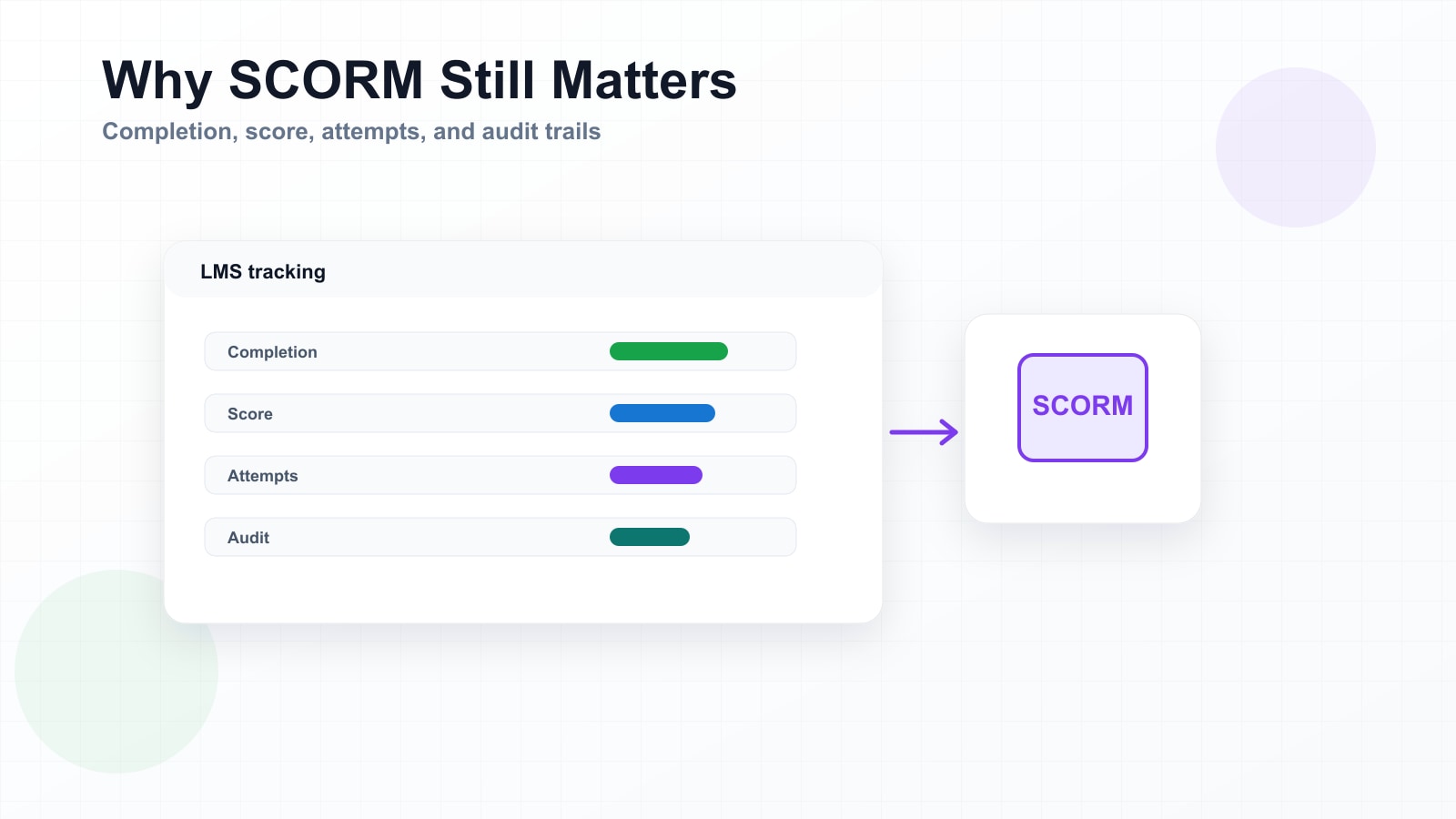
SCORM turns 24 this year. In software terms, that makes it ancient — older than most of the LMS platforms it now runs on, older than most of the tools used to build the content that ships inside it. And yet almost every serious learning management system still expects it, almost every corporate training mandate still requires it, and almost every RFP for an authoring tool still asks whether the output is SCORM compliant.
If you're evaluating training tools and wondering whether SCORM compatibility is still worth caring about, the short answer is yes — but the reason isn't nostalgia. It's what SCORM actually does that nothing else quite replaces.
What SCORM actually is, in plain terms
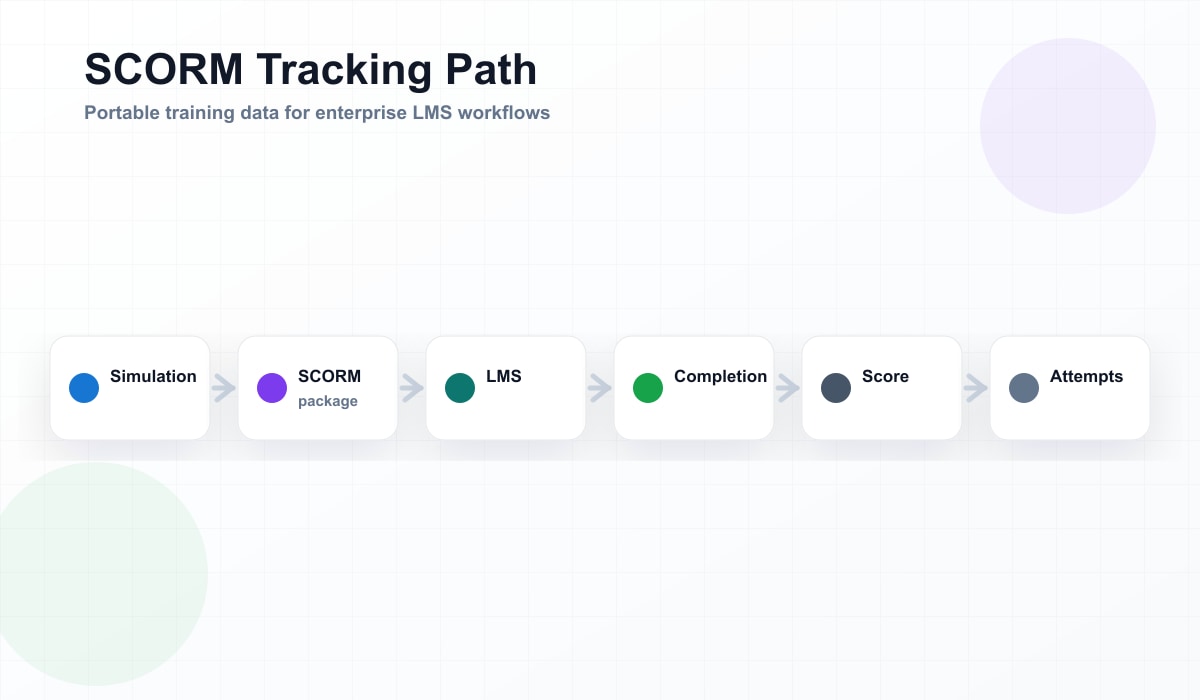
SCORM (Sharable Content Object Reference Model) is a technical standard that defines how a piece of e-learning content talks to the system hosting it. When a learner opens a SCORM package inside an LMS, two things happen automatically, without any custom integration work:
- The LMS knows whether the learner completed it, and how they scored.
- That data lands in the LMS's own gradebook and reporting — the same place every other course's data lives.
That's the entire value proposition, and it's a bigger deal than it sounds. Without a shared standard, every piece of training content would need its own custom connection to track completion — which is exactly the mess that existed before SCORM standardised it in the early 2000s.
Why it hasn't been replaced
SCORM has real limitations — it wasn't built for mobile-first learning, offline tracking, or the kind of granular data that xAPI (its intended successor) can capture. xAPI has existed for over a decade specifically to address those gaps. And yet SCORM remains the default that almost every LMS supports out of the box, while xAPI support is often an add-on or a paid tier.
The reason is inertia with a good excuse: switching standards means re-certifying content, retraining L&D teams, and asking every LMS vendor in a multi-system enterprise to guarantee compatibility. For most organisations, that cost outweighs what xAPI's extra data actually buys them. SCORM does the one job most compliance and rollout training actually needs — did they finish it, did they pass it — reliably enough that there's rarely a compelling reason to move.
SCORM isn't the most powerful standard available. It's the one every system in the building already agrees to speak.
Why this matters more than it seems for a training rollout
For a project manager or change manager running a software rollout, SCORM compatibility usually shows up as a one-line requirement in a vendor checklist — easy to overlook until it isn't there. A few reasons it earns that line item:
- No extra IT project. A SCORM package uploads into an existing LMS the same way any other course does. There's no separate integration to scope, approve, and wait on.
- Completion data lives where stakeholders already look. Executives checking rollout readiness don't need a new dashboard — the numbers show up in the same gradebook they already check for every other mandatory course.
- It travels with the organisation. If the company migrates LMS platforms later — which happens more often than anyone plans for — SCORM content moves with minimal rework, because every major LMS on the market still reads the same format.
What "SCORM compliant" should actually guarantee
Not all SCORM output is equal. When evaluating a training or simulation tool, the practical test isn't just "does it export SCORM" — it's whether that package behaves correctly across the LMS platforms your organisation actually uses. A quick reference for what should just work, without custom configuration:
| What it should do | Why it matters |
|---|---|
| Upload as a standard activity or course object | No plugin, no IT ticket, no custom setup |
| Report completion status automatically | Shows up in the gradebook you already use |
| Report scores for Test-mode content | Lets you distinguish "watched it" from "can do it" |
| Work identically across SCORM 1.2 and 2004 | Covers older and newer LMS configurations without extra work |
That's the bar. Anything less, and "SCORM compliant" becomes a checkbox that technically ticks but practically creates work for someone in IT or L&D down the line.
SCORM output that just works, wherever your LMS is
Standard SCORM 1.2 and 2004 packages, tested across Moodle, Canvas, Cornerstone, SAP SuccessFactors, and every other SCORM-compliant platform.
Try It Free