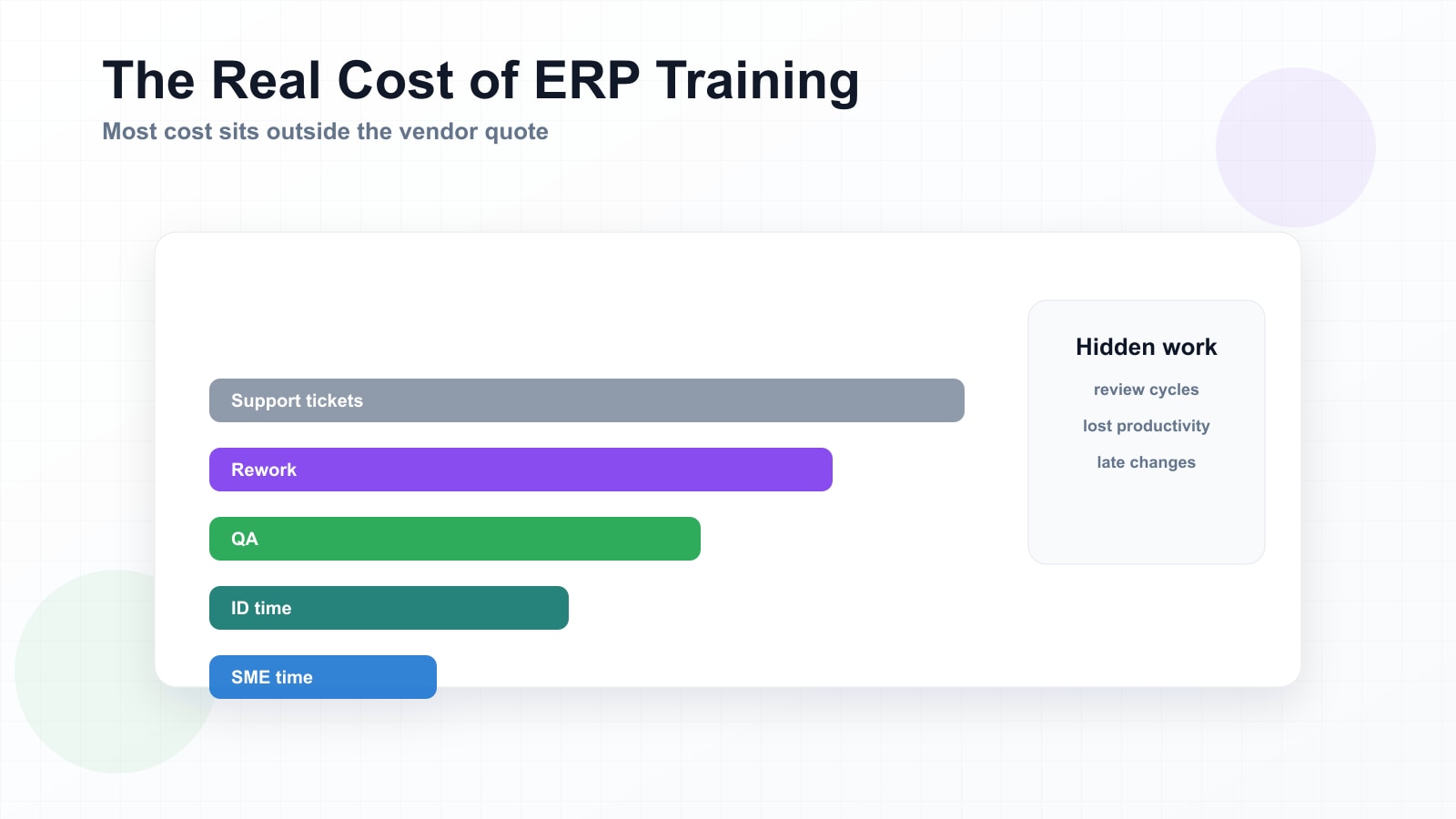
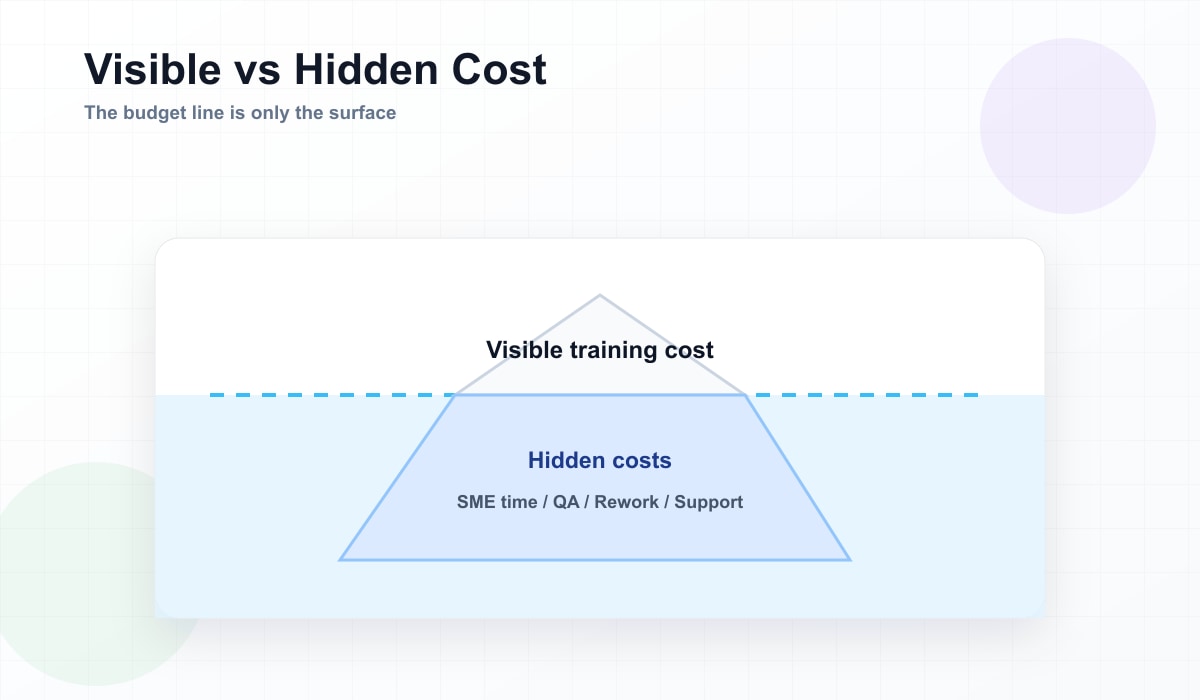
When organisations budget for an ERP rollout, training is rarely the headline number. The software license, the implementation partner, the infrastructure — these are the figures that get scrutinised in steering committees and board presentations. Training gets a line item, but it's often treated as a rounding error.
It shouldn't be. Training time is employee time. Employee time is cost. And at enterprise scale, that cost adds up to numbers that deserve the same scrutiny as any other major budget item.
A simple framework for thinking about training cost
The math isn't complicated. You need three numbers:
- Training hours per employee. How long does each person spend in training? Include live sessions, self-paced modules, practice time, and any mandatory assessments.
- Number of employees. How many people need to complete the training? For a core system rollout, this is often everyone in certain roles — potentially thousands of people.
- Average fully-loaded hourly cost. What does an hour of employee time actually cost the organisation? This isn't just salary — it includes benefits, overhead, and the opportunity cost of that person not doing their regular work.
Multiply those together, and you get the productivity cost of training — the value of work that didn't happen because people were in training instead.
Five million dollars. That's before you count the cost of producing the training content, the trainers' time, the LMS infrastructure, or any vendor fees. That's just the cost of having people sit through training instead of doing their jobs.
Training time isn't free just because it doesn't show up on an invoice.
Why this number gets underestimated
There are a few reasons training cost tends to slip under the radar:
- It's distributed. The cost is spread across thousands of employees and dozens of departments. No single budget holder sees the full picture.
- It's not a cash outflow. Unlike vendor fees, training time doesn't generate an invoice. It's an opportunity cost, and opportunity costs are easy to ignore.
- It's hard to attribute. If an employee spends 10 hours in training, that time disappears into their regular workweek. It doesn't get tracked separately or reported upward.
But invisible doesn't mean free. That time comes from somewhere — usually from overtime, delayed work, or simply less output during the rollout period.
The recurring cost no one budgets for
The calculation above is for initial training — the first time employees learn the new system. But software doesn't stay static. Updates ship. Processes change. Bugs get fixed and workflows get adjusted.
Every time the system changes in a way that affects how people use it, some version of retraining happens. Maybe it's a quick refresher. Maybe it's a full module update. Either way, the cost recurs — and it's rarely budgeted.
Over the lifetime of an ERP system, the cumulative cost of training updates can exceed the cost of the initial rollout training. The question is whether those updates are efficient (quick to produce, quick to complete) or whether they repeat the same expensive cycle every time.
Where the time actually goes
If you break down those 10 training hours, you'll often find that a significant portion isn't actually learning. It's logistics:
- Scheduling around live sessions that don't fit everyone's calendar
- Waiting for a trainer to answer questions in a group setting
- Sitting through content that's irrelevant to your specific role
- Repeating sections you already understood because there's no way to skip ahead
Self-paced, on-demand training cuts much of this overhead. Employees complete the training when it fits their schedule, skip what they already know, and spend time on the parts that actually need attention. The total hours drop not because the training got worse, but because the waste got removed.
What this means for training design
If training time is real cost, then reducing training time — without reducing effectiveness — is a real saving. That's not an argument for cutting corners. It's an argument for efficiency.
- Self-paced beats scheduled. Live sessions have their place, but mandatory attendance for generic content is expensive. Let people complete foundational training on their own time.
- Targeted beats comprehensive. Not everyone needs every module. Role-based paths reduce hours without reducing relevance.
- Practice beats presentation. Hands-on practice is more efficient than passive watching. People learn faster when they're doing, not just observing.
Each of these reduces the hours-per-employee number in that calculation. At scale, even small reductions translate to large savings.
A question worth asking
Before the next rollout, it's worth doing the math: how many hours of training, multiplied by how many employees, multiplied by what hourly cost? The answer might be larger than anyone expected — and large enough to justify investing in training that's actually designed to be efficient.
Cut the time, not the coverage
Self-paced modules your team can complete on their own schedule — no live session to schedule around.
Try It Free