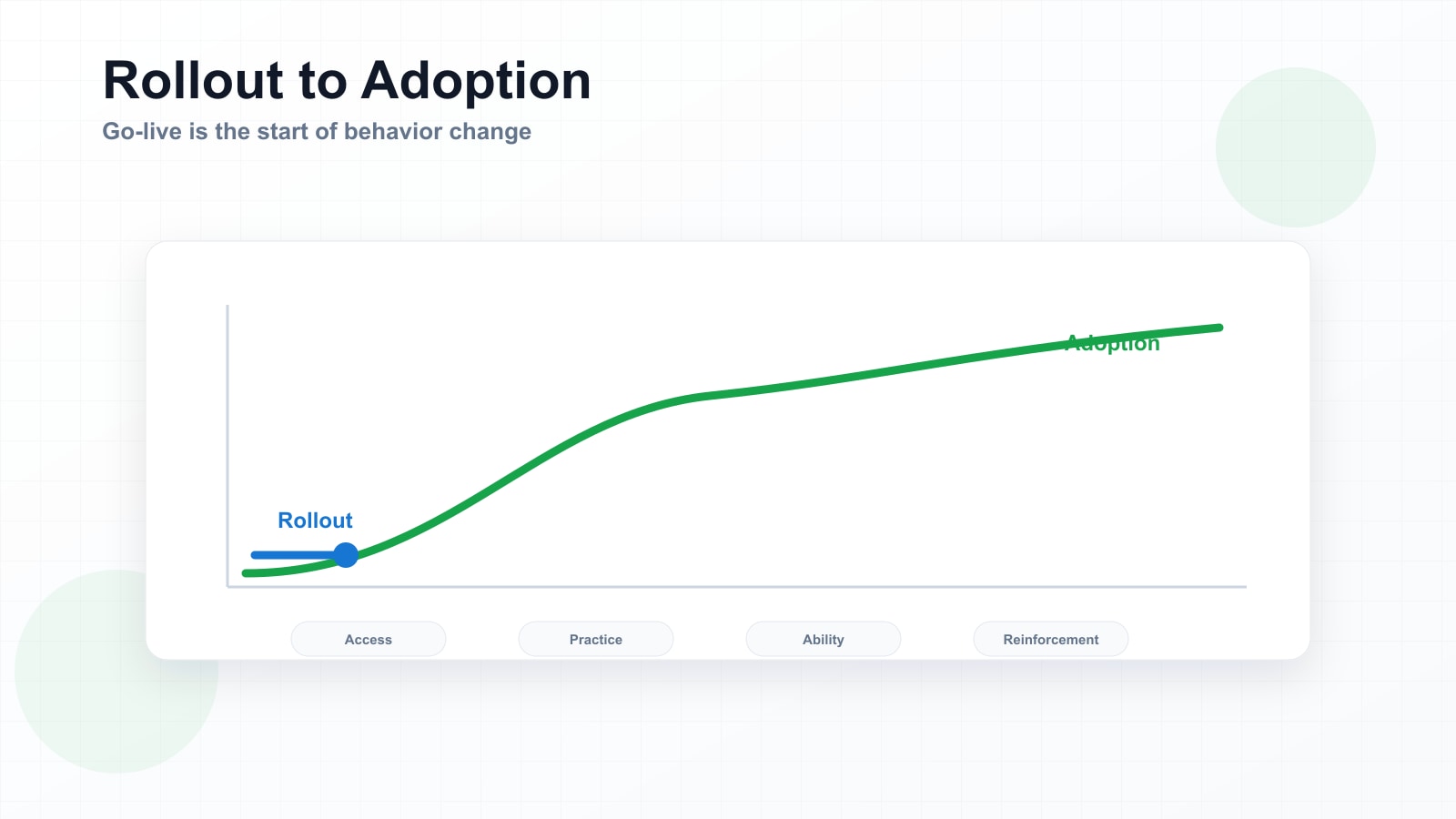
Most software rollouts follow the same shape. Procurement signs off. IT configures the environment. A launch date gets circled on the calendar. Somewhere near the end of that timeline, someone remembers that people actually have to use the thing, and training gets slotted in as the last box to tick before go-live.
That sequencing is the problem. Training treated as a final communication step — a webinar, a PDF, a link to a recorded walkthrough — assumes the hard part is telling people what changed. The hard part is almost never that. It's getting people to change what they actually do at their desk on a Tuesday afternoon, under deadline pressure, when the old way still feels faster because it's familiar.
Change management already knows this. Training often doesn't.
If you work in change management, none of this is new. ADKAR, Prosci, Kotter — every serious change framework treats awareness and communication as necessary but nowhere near sufficient. Desire, knowledge, ability, reinforcement — the framework only holds up if people can actually do the new process, not just recall that it exists.
The gap is that the training artifact usually doesn't match the change model producing it. A change manager building a rollout plan around ability and reinforcement often ends up handing that plan to a training process that only knows how to produce awareness content — a screen-recorded video, a slide deck, a written guide. Good communication. Weak transfer.
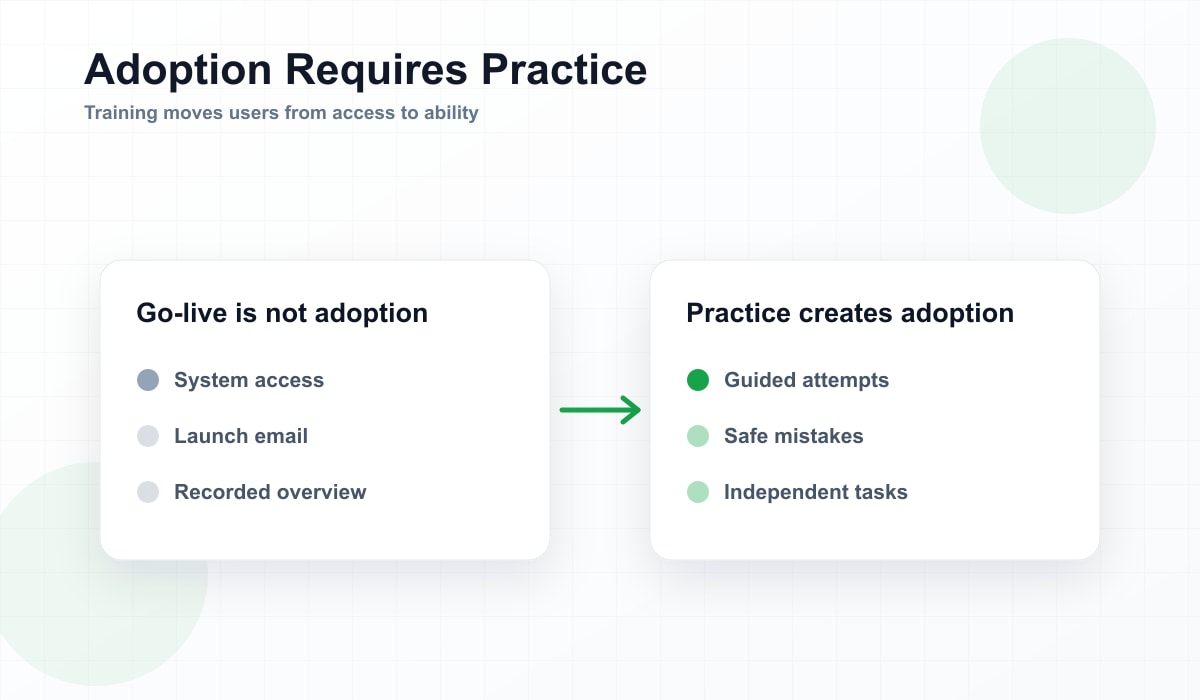
Watching is not the same skill as doing
This is not a criticism of the people building training content. It's a structural issue. Most teams rolling out new software don't have an instructional designer on staff. What they have is a process expert who understands the workflow cold, and a change manager who understands the rollout timeline — neither of whom has the time or the tooling to build something more interactive than a recorded walkthrough.
So the training defaults to the easiest format to produce, not the format most likely to change behaviour. Employees watch someone else click through the new system, nod along, and then sit down at their own desk with no memory of where the button actually was.
The people who understand the process best are rarely the people equipped to build a way for others to practice it.
What training as "part of the change journey" looks like in practice
Treating training as part of the change journey — rather than the closing slide of it — usually means three shifts:
- Training starts earlier, not later. If people can start practicing a new workflow in a safe, low-stakes environment before go-live, the go-live itself stops being the first time they've touched the new process.
- The content lets people fail safely. A recorded video has no room for a wrong click. A guided simulation does — and a wrong click followed by a correction is closer to how people actually learn a workflow than watching someone else get it right the first time.
- It survives the next change. Rollouts rarely stop at go-live. Configuration tweaks, bug fixes, and phase-two features keep landing for months afterward, and each one quietly makes yesterday's training material a little more wrong.
That last point is the one that gets underestimated the most. A change manager plans for the rollout. Few plan for the fact that the training material itself needs its own maintenance cycle — one that usually isn't budgeted for, because the original training was treated as a one-off deliverable rather than something that needs to track the software as it evolves.
The maintenance problem nobody budgets for
Ask most PMs or change managers what it costs to build the first version of a training module, and they'll have a number. Ask what it costs to update that module three months later, after a UI change or a process fix, and the answer is usually a shrug — because updating training has traditionally meant redoing a large share of the original work: re-recording, re-scripting, sending it back to an agency, waiting in a production queue.
That hidden, recurring cost is often larger over a year than the cost of the original build. It's also the reason training tends to fall behind the software it's meant to explain — not because anyone decided accuracy didn't matter, but because keeping it current was never made easy enough to actually happen.
See what training built for change actually looks like
Demo, Practice, and Test modes built from the screen recordings your team already knows how to make — and quick to update when the process changes again.
Try It Free